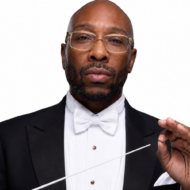
There are people who work at a place, and then there are people who become part of its architecture. At the Apollo Theater, Billy “Mr. Apollo” Mitchell is decidedly the latter.
You may know him as the familiar face greeting visitors, guiding tours and telling stories about the performers who have crossed that legendary stage. But Mitchell’s relationship with the Apollo reaches well beyond the microphone and the familiar anecdotes. For six decades, he has been one of the living connections between the theater, its artists and the Harlem community that made it an international institution.

The Apollo recently gave that relationship a new title. Mitchell has been named Apollo Ambassador and Senior Curator of Community and Cultural Engagement, an expanded role recognizing his institutional history while placing community connection more explicitly within his responsibilities. The Apollo’s announcement describes the appointment as an expansion of his role in strengthening the theater’s enduring ties to Harlem.
It is an appointment with a particular kind of significance. Cultural institutions often celebrate their histories through archives, exhibitions and anniversary programs. The Apollo has something less easily catalogued: a person who remembers the people, personalities and everyday moments that made those histories possible.
Mitchell’s own Apollo story began in 1965, when he was just 15 years old. In his account to The New York Times, his mother sent him from the Bronx to borrow money from an aunt who lived across from the theater. When he discovered she was not home, he waited near the stage door. He eventually found himself running an errand for performers, fetching coffee for the evening’s show.

One errand became an introduction. An introduction became a career.
Over the years, Mitchell worked in numerous capacities at the Apollo. He became a familiar presence, a historian of the institution and a public-facing keeper of stories that might otherwise disappear between generations. His tours have offered visitors more than a chronological account of famous performances. They have provided a sense of what it felt like to be inside the building, to encounter its artists and to understand why this particular stage matters.
And the stage matters. The building opened in 1914 and became the Apollo in 1934. Its history is inseparable from the development of Black American entertainment. Generations of musicians, comedians, dancers and performers encountered audiences there, while Amateur Night helped make the theater a place where emerging talent could be tested before a famously discerning crowd.
But a landmark is not sustained by its marquee alone. It requires people who understand the neighborhood around it, who can explain why a performance matters beyond the applause and who recognize that cultural history is not simply something to preserve behind glass.

That is where Mitchell’s expanded role becomes especially interesting.
According to the Apollo, his responsibilities include strengthening relationships with Harlem residents, businesses and community organizations; maintaining connections with elected officials, clergy and cultural leaders; continuing historical tours; and representing the theater at education programs and community events. He will also work with Apollo leadership so that community questions, priorities and ideas inform institutional planning and decision-making.
That last responsibility deserves attention. The word “community” appears frequently in cultural announcements. It can describe an audience, a constituency, a fundraising category or a neighborhood an institution hopes to reach. The more meaningful question is whether engagement creates an actual channel for influence.

What happens when residents have concerns? How are their ideas collected? Who responds? And how does an institution demonstrate that listening has changed a decision?
Mitchell’s appointment creates an opportunity to make those questions part of the Apollo’s next chapter. His familiarity with Harlem is not a substitute for a formal community process, but it gives the institution a trusted bridge between its leadership and the people whose cultural inheritance it represents.
That bridge is particularly important as the Apollo completes its largest restoration, renovation and modernization of the Historic Theater in more than 90 years. The work includes improvements to public spaces, seating, backstage areas and the marquee. The institution says the project is intended to prepare a historic venue for another generation without losing the character that made it significant. Details are available through the Apollo renovation project page.
On December 19, the Apollo plans to welcome the community back inside for Apollo Homecoming: Community Day and Open House. The free event is scheduled for noon to 5 p.m. at 253 West 125th Street. Visitors are expected to explore the renovated spaces and take part in family-friendly activities. Registration and event details are on the official Homecoming page.

There is an important distinction: Homecoming is a community open house, not the theater’s full public reopening. The Apollo has indicated that its public opening is planned for spring 2027. December’s gathering is an opportunity for Harlem to encounter the building again, see what has changed and consider what it wants the Apollo to become.
There is a temptation to describe Mitchell’s appointment entirely as a tribute to the past. That would miss the more compelling story. His new title is also about the future: how an institution carries its memory forward, how it remains accountable to its neighborhood and how it makes sure the next generation sees the Apollo as more than a famous address.
The theater has welcomed the world to Harlem for generations. The next chapter should make sure Harlem continues to feel welcome there, too.

Question of the Day
What makes a cultural institution truly belong to its neighborhood: its history, its programming, the people who work there or the people who feel they have a voice in its future?
Stay in the Mood
Follow the Apollo’s renovation and Homecoming announcements at apollotheater.org. Apollo Homecoming is scheduled for December 19, 2026, at the Historic Theater in Harlem.