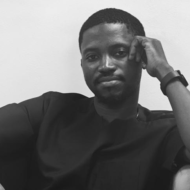

Tribute to the One Who Wears the Big Hat in the Slum
By Minkail Olaitan
He turns thirty-two today, and the photographs will do what photographs do. They will catch the hat, the board, the children who have learned to sit still long enough to think. They will not catch the hip. They will not catch the two years after primary school when Babatunde Onakoya stayed home in Isale Odo, Ikorodu, while his mates moved into junior secondary because the house could not pay for both sons. They will not catch Iya Pupa, his mother, cleaning other people’s floors and washing other people’s clothes so that her boy might one day speak among his peers. She told him that in Yoruba, and sometimes she cried when she said it. He did not understand the sentence until years had passed.
Born on 6 October 1994, first in Ketu, then in the slum that finished the lesson, he was not raised for a stage in Times Square. A quack nurse and a measles injection at nine months left him with a bad leg and a pain that stayed for twenty-eight years. The name, when it finally came, was avascular necrosis of the right hip: bone dying because the blood would not arrive. He walked anyway. He limped into a barbershop in Ikorodu and learned chess by watching men play, the way the poor learn most lasting things, without a fee and without permission. The board did not ask for school fees. It asked for attention. He had that. Poverty had already taken the doctor he might have been. It had not taken the eye.

This is the part the glistening story skips, and it is the part that makes the rest intelligible. None of it began with a smile. It began with a burden: a mother on her knees in another woman’s kitchen, a father driving a danfo and, on the worse days, conducting it, a boy pretending to be ill so he could sneak to a game centre because the alternative was an empty afternoon. Chess in Slums Africa, begun in 2018, is not a brand that discovered poverty. It is a man walking back into Majidun with a board and a pocket of dreams, then into Makoko, then under the bridge at Oshodi, calling children by names the street had refused them. He has said the miracle of the game is the pawn’s right to become a queen. He has also said chess is a great equaliser: black or white, rich or poor, the squares do not care. He had watched that promotion in other hands. He decided his own hands would be the dexterous ones. A curriculum, then. Not a lecture. A way for children already beaten down to the pawn square to move themselves, step by step, toward a square the world might have to respect.
The hip replacement came when he could finally pay for it, years of bone already spent. Recovery is not a montage. It is learning the leg again. Then, in April 2024, under the advertisements of Times Square, he sat down with Shawn Martinez and refused to stand up. The old record was fifty-six hours. He had come for fifty-eight. He pushed to sixty, and said why in the plainest sentence a tired man can manage: the education of African children. A year later the official mark went to sixty-four. People will remember the lights. The body that sat there had already done a longer shift, from nine months old to the night the record fell. When it gets tougher, it is about to get better. He did not learn that from a poster. He learned it from a tunnel that had no lamp at the end, so he carried his own.
Mother Teresa kept a harder version of that sentence on a wall in Calcutta. What you spend years building, someone could destroy overnight. Build anyway. The good you do today, people will often forget tomorrow. Do good anyway. Give the world the best you have, and it may never be enough. Give the best you have anyway. She was not offering comfort. She was describing the job. The same job has other names. Wangari Maathai was beaten, jeered and jailed for planting trees against a government that preferred the forest bare, and still the Green Belt Movement put millions of trees into Kenyan ground and a Nobel into a woman’s hands that had known the baton. Malala Yousafzai took a bullet to the head for wanting a classroom and came back as a school. Abdul Sattar Edhi began with a single ambulance in Karachi and a life the city had already decided was small, and built a mercy so wide that Pakistan measured its emergencies by whether Edhi had arrived. None of them were light because the furnace was kind. They were light because the furnace had already had them, and they came out carrying something that could be given away.

That is the Onakoya the birthday will under-tell. The supposed light at the end of the tunnel was a fallacy he stopped waiting for. He kept his own flicker and walked it to the back of the dark. What you meet there is not a rescued man posing with a trophy. It is the light. Light in Makoko. Light out of Ikorodu. A flicker that has since been asked to cross water and sit under foreign neon, still answering to the same children. The sea was turbulent. He did not wait for it to settle. He toughened until he could meet it.
On the board he has made a small republic where a child functions at full capacity, if only for an hour. Pawns become queens under patient hands. He has seen it. He has been it. The audacity was forged in storm, not in applause, and that is why it does not depend on applause to continue. Today the hat will be photographed. Let the photograph keep the hip, the barbershop, the mother who cleaned for a sentence her son did not yet understand, and the sixty hours that were only the visible end of a much older sitting. He shines like sunshine because he was forged. The tunnel did not provide the light. He did. And he took it back to the children still standing where he once stood, waiting for someone who had already survived the furnace to show them the next square.

QUESTION OF THE DAY
What if the greatest measure of a life is not how far you escape the darkness, but how much light you carry back for those still inside it?

STAY IN THE MOOD
Keep building. Keep believing. Keep moving toward the next square.
Tunde Onakoya reminds us that sometimes the light at the end of the tunnel is not something waiting for us.
Sometimes, we have to carry it ourselves.
And when we find our way through, we have a responsibility to carry that light back to the people still waiting for a chance.
Stay courageous. Stay curious. Stay in the Mood.