
Awards Season 2026 | Honoring 2025 Work
By Mood Magazine
Awards season often rewards momentum. Mood honors mastery.
In a year crowded with content, African American men in film, television, and stage delivered performances that cut through noise with discipline, specificity, and intention. These were not performances engineered for algorithms or applause breaks. They were grounded in craft, lived experience, and a deep understanding of character.
Before nominations harden into narratives, Mood is naming the men whose work actually shaped the year.

Colman Domingo: Presence as Authority
Colman Domingo has spent decades building one of the most respected careers in contemporary performance, moving fluidly between theater, television, and film. Classically trained and theater-rooted, Domingo brings a playwright’s intelligence and a director’s perspective to every role.
This year, his work reflected an artist operating at full command of his instrument. Domingo does not disappear into characters — he clarifies them. His performances are grounded in voice, posture, and intention, making even stillness feel active.
What distinguishes Domingo is his understanding of presence. He does not rush emotional beats or overstate significance. He allows scenes to breathe, trusting that truth will land without force.
Why Mood Is Rooting for Him:
Because Domingo represents a model of African American masculinity rooted in intelligence, vulnerability, and authority — without caricature.


Sterling K. Brown: Emotional Precision at Scale
Sterling K. Brown’s career has been defined by emotional accessibility paired with technical precision. From television breakthroughs to increasingly layered film work, Brown has demonstrated an ability to make interior life legible without flattening it.
This year, his performances continued to balance intimacy with scope. Brown understands how to carry emotional weight across long narrative arcs, allowing characters to evolve without abandoning coherence. His work feels lived-in — not performed for effect.
Brown’s greatest strength lies in empathy. He invites audiences into emotional spaces that feel recognizable without being simplistic.
Why Mood Is Rooting for Him:
Because sustained emotional truth across mediums is a rare skill — and Brown executes it consistently.


Jeffrey Wright: Intellectual Gravity on Screen
Jeffrey Wright has long occupied a singular space in American acting. Trained in theater and known for his intellectual rigor, Wright approaches performance as inquiry. His characters often wrestle with power, morality, and consequence — and Wright never reduces those tensions for ease of consumption.
This year’s work reaffirmed his status as one of the most cerebral performers of his generation. Wright does not ask for attention; he commands it through clarity of thought and economy of movement. Every gesture feels considered.
In an era that often favors speed over substance, Wright’s performances slow us down — and demand reflection.
Why Mood Is Rooting for Him:
Because acting that respects the audience’s intelligence strengthens the art form itself.


Brian Tyree Henry: Vulnerability as Strength
Brian Tyree Henry’s rise has been marked by emotional openness and fearlessness. With roots in theater and a breakout that redefined expectations, Henry has built a career on portraying men who feel deeply — often at great personal cost.
This year, his performances continued to challenge narrow definitions of masculinity. Henry allows tenderness, grief, and uncertainty to exist without apology. His characters are not aspirational in a traditional sense — they are human.
Henry’s work resonates because it feels unguarded. There is no armor between performer and audience.
Why Mood Is Rooting for Him:
Because vulnerability, when handled with this level of discipline, is revolutionary.

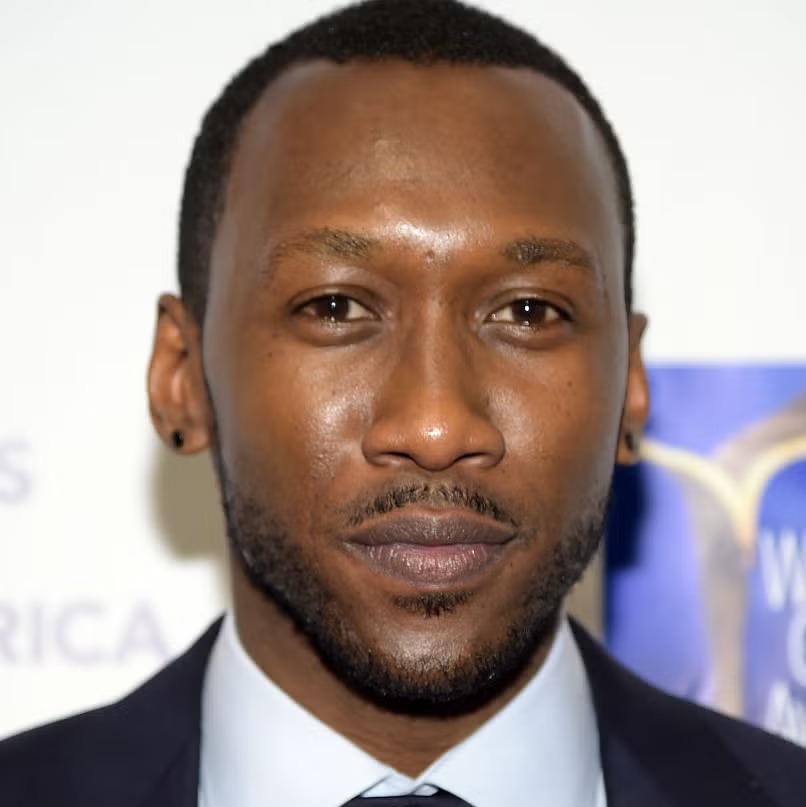
Mahershala Ali: Stillness as Power
Mahershala Ali’s career has been defined by restraint, discipline, and intentionality. Trained as an actor and grounded in spiritual practice, Ali brings a centeredness to his work that translates into profound screen presence.
This year’s performances reinforced his mastery of minimalism. Ali understands how little is required to convey depth when every choice is precise. His characters often speak volumes without explanation, their inner lives revealed through posture, silence, and gaze.
Ali does not chase moments. He builds atmospheres.
Why Mood Is Rooting for Him:
Because excellence does not need excess — and Ali exemplifies that truth.
What the Men of This Year Represent
Taken together, these performers reflect a broader evolution in African American male representation. Their work resists extremes — neither hardened caricature nor sanitized respectability. Instead, it embraces complexity, intelligence, and emotional range.
These men did not simply perform roles.

They expanded the vocabulary of what African American masculinity looks like on screen and stage.
Mood is not waiting for trophies to say so.
Join the Conversation
Who do you believe should win this awards season?
Which performance stayed with you long after the final scene?
Follow @MoodMagazineNYC and add your voice — culture is shaped by those who speak.